Physically unclonable functions (PUFs) are a promising solution for anticounterfeiting technologies. However, their mass implementation is limited by fabrication complexity and/or special materials demands, as well as specialized authentication. To overcome these issues, a scalable and sustainable approach for fabricating optical PUF labels is proposed in this work. The approach is based on direct laser metallization (DLM) of deep eutectic solvents on flexible polyimide substrates. The laser-induced reduction of copper precursors produces microstructures made by specially designed templates with stochastic edge morphologies serving as unique unclonable identifiers. A computer vision–based authentication algorithm enables robust recognition, achieving an encoding capacity exceeding 10^465. The created labels can be authenticated using standard microscopes or consumer smartphones with macro lenses. Additionally, created labels were tested for stability and unauthorized copying. The replication attempts using 1200 dpi laser printing reproduced macroscopic outlines but failed to mimic microscopic features, confirming their unclonability. The fabricated labels remain functional after exposure to running water and heating up to 200°C, demonstrating excellent environmental durability. Due to its flexibility, scalability, and low-cost eco-friendly processing, the proposed label design is well suited for integration into flexible and wearable microelectronic systems, providing a practical solution to next-generation anticounterfeit technologies.
About
A physically unclonable label gets its pattern not from a file but from the randomness of laser processing. Even its maker cannot reproduce the pattern, so such a label protects goods and documents better than a printed code. The team covers the whole chain, from the physics of nanostructures and laser printing to recognition and authentication algorithms.
Different physical systems carry the randomness. Resonant silicon nanoparticles produce color through Mie resonances, hybrid gold–silicon structures emit nonlinear white luminescence, and the spread of their nanoscale sizes shows up in the spectrum and works as a key by itself. Silicon–erbium films glow in the telecom infrared range, so the pattern is invisible to the eye. Copper microstructures are laser-reduced directly on flexible polyimide, and such a label withstands water and heating up to 200 °C.
Verification needs no laboratory equipment. The pattern is captured with a microscope or a smartphone with a macro lens, and computer vision compares it with the reference. Hidden security levels come from polarization, as scattering by hybrid nanoantennas changes with the viewing angle, and from an infrared channel for forensic checks. A copy printed at 1200 dpi fails the check.
Interested in working together?
Tell us about your research task or project idea, and we will discuss possible areas of collaboration and our team’s expertise
5
people on the team
12
publications
158
citations
6
h-index
89%
papers in Q1 and Q2
4
papers since 2024
Team
Dmitry Zuev
PhD in Physics and Mathematics, leading researcher
Pavel Kustov
PhD in Physics and Mathematics, researcher
Elena Petrova
3rd-year PhD student, junior researcher
Martin Sandomirskii
2nd-year master’s student, laboratory assistant
Maria Fedorova
3rd-year bachelor’s student, laboratory assistant
Publications
all publications
Polarization of light provides an additional degree of freedom in nanostructure-light interactions and delivers a wide variety of physical phenomena and applications. While relatively well-described for plasmonics and high-refractive-index nanosystems, the potential for polarization-dependent control of optical properties in hybrid nanostructures composed of two or more materials remains not fully unlocked. Here, we study the polarization-dependent scattering behavior of resonant hybrid gold–silicon nanostructures lacking inversion symmetry. We adjust the geometrical configuration and material phase of the nanostructure components through precise femtosecond laser irradiation to induce polarization-dependent changes of scattering spectra. By evaluating the color change using the color-difference (Δ E *) formula, we demonstrate Δ E * values of approximately 9.7 and 3.9 for TE- and TM-polarized oblique illumination, respectively. Notably, the latter value is close to the just noticeable difference threshold of 2.3 calculated for the studied nanosystems. Numerical simulations and semianalytical multipole decomposition techniques are applied to investigate this polarization-dependent scattering behavior, revealing that for the studied hybrid nanosystem, this phenomenon occurs at illumination angles ranging from 57° to 75°. Finally, we developed an effective defense mechanism against counterfeiting. The achieved results hold significant potential for further research into hybrid nanophotonic systems and for the development of optical chips, sensors, and anticounterfeit systems.

Optical physical unclonable functions (PUFs) are state-of-the-art in advanced security applications. Fabricated with inherent randomness, they generate fingerprint-like responses, serving as trust anchors for material assets. However, the existing PUFs, typically reliant on microscopic spatial features, face increasing threats from rapidly advancing microscale manipulation techniques. Here, we present novel PUFs based on random nanoscale variations within multi-resonant gold-silicon particles. These inevitable structural differences, coupled with strong optical resonances, provide unique spectral features in particles' photoluminescence (PL), which we encode as unclonable keys. Our approach surpasses the shortcomings of diffraction-limited designs, additionally offering a multi-functional platform for robust authentication of goods and verification of individuals. We demonstrate two security label models based on PL mapping and direct PL imaging, as well as a concept for the first all-optical one-time password verification token with an exceptionally high storage density of unique information. This work paves the way toward nanoscale-enabled unclonability, bringing enhanced security for hardware-based cryptography, personalized access control, and cutting-edge anti-counterfeiting.

Authentication of a product's originality by anticounterfeiting labels represents a crucial point toward protection against forgery. Fast and scalable fabrication methods of original labels with a high degree of protection are in high demand for the protection of valuable goods. Here, we propose a simple strategy for fabrication of hidden security tags with IR luminescent readout by the direct femtosecond laser patterning of silicon-erbium-silicon sandwiched thin films. The choice of laser processing parameters makes possible the creation of random or quasi-regular self-organized surface nanotextures. The controlled laser-driven oxidation accompanying this process provides simultaneous regulation of the film's optical properties and spontaneous emission yield of the embedded Er atoms. The regimes are detected when optically similar patterned areas demonstrate different Er emission intensities, allowing us to create hidden security tags with facile readout at the C-band telecommunication wavelengths. The obtained results take another step toward the application of IR-luminescent erbium-based anticounterfeiting labels for covert and/or forensic security levels.

To keep up with the growing needs for data storage, new-generation nanophotonic devices are being actively developed, as they have a high potential to meet all the essential industrial requirements. In addition to the high stability and capacity of such systems, it is highly desirable to provide them with additional security features that would protect data from unauthorized reading. However, this usually leads to inevitable and critical complications of existing recording techniques. This work presents a novel and facile technology for hidden data storage, based on femtosecond laser processing of bi-layer gold-silicon films at low energy densities. It is shown that the recorded data can be successfully extracted using photoluminescence signal mapping, while remaining completely invisible in an optical microscope. Furthemore, the use of the investigated procedure for the optical random key generation is also demonstrated. The proposed technology stands out for its simplicity and reliability and, thus, has the potential to be an excellent choice for industrial use in the upcoming era of secure optical communication.
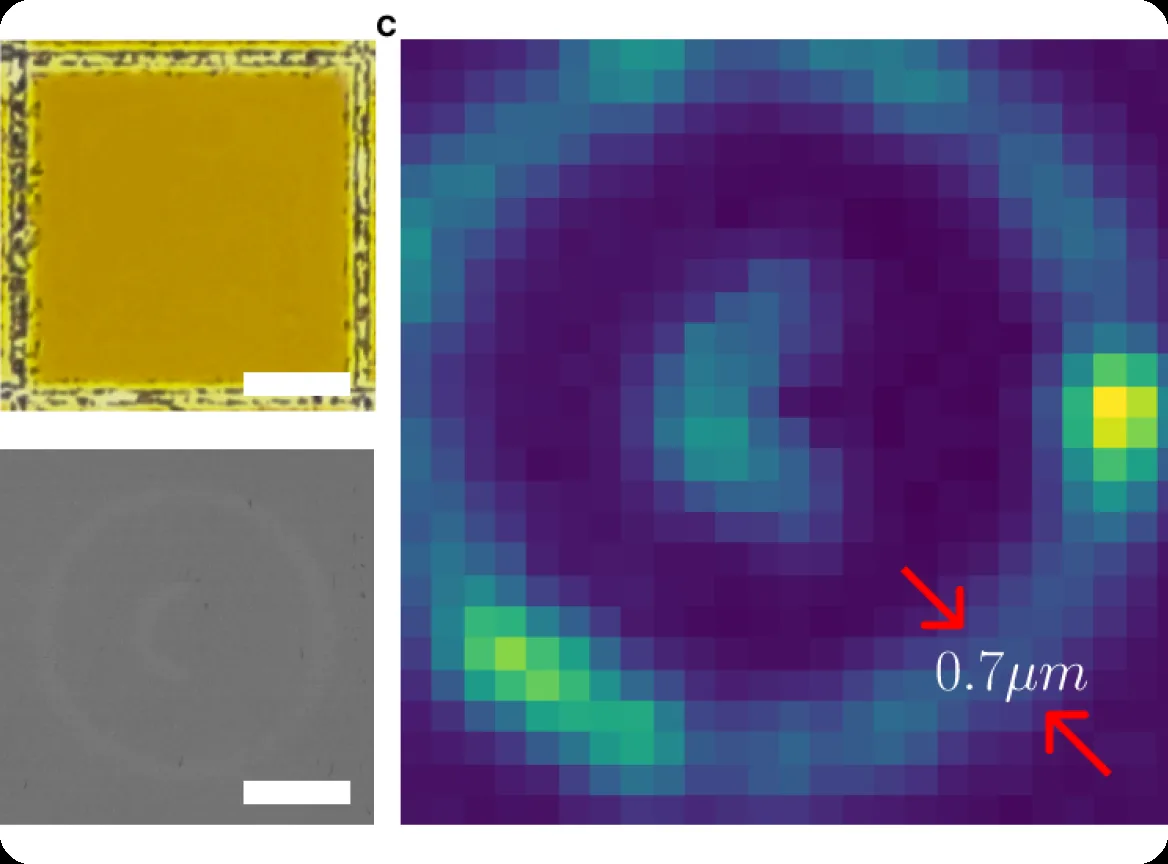
Anti-counterfeiting labels based on nanoobjects with stochastically varied parameters are of immense interests in the last decade. In addition to an object size and its coordinate, the inherent properties of nanoobjects play an important role in the label encoding. Recently, we have demonstrated physically unclonable security label with multilevel authentication based on resonant silicon nanoparticles. The label was printed using laser induced forward transfer, providing unique spatial/color coordinates and nanoparticles radius distribution. In this paper we propose additional encoding level through utilization of multiphoton-induced silicon photoluminescence.

Showing 6 of 12